
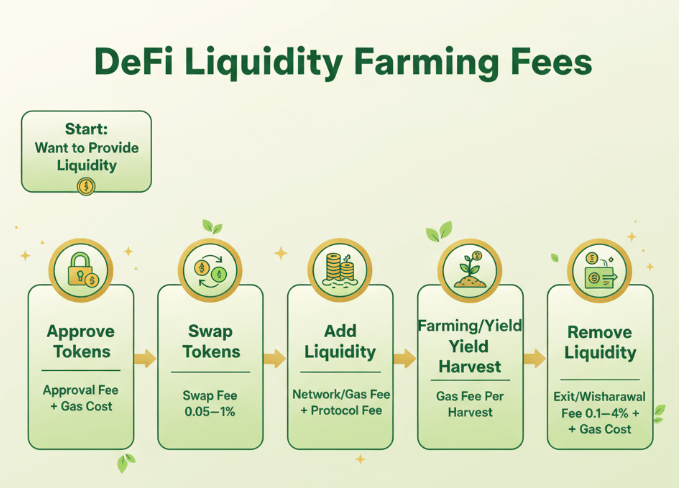
So, you’ve decided to become a DeFi farmer, planting your digital beans and watching that sweet passive income grow. But before you start counting your crypto chickens, there’s a sneaky little pest waiting in your yield garden—fees.
Yes, the world of liquidity farming is full of clever ways to nibble at your profits like DeFi’s version of hungry rabbits in your backyard. This guide breaks down every crypto fee you’ll face when adding, farming, or withdrawing liquidity—so you can farm smart, not sorry.
💨 Network (Gas) Fees: The Crypto Cover Charge
Every move you make in DeFi requires a bit of blockchain energy—better known as gas fees. You’ll pay gas when you:
- Approve tokens
- Add liquidity
- Remove liquidity
- Adjust your farming position
On Ethereum Mainnet, these costs can fluctuate faster than meme coin prices—ranging from a few bucks on a quiet Sunday to “sell‑a‑kidney” levels during peak congestion.
Good news? Layer 2 solutions like Arbitrum, Optimism, or Polygon offer cheaper, faster transactions. Bad news? Every “approve,” “deposit,” or “harvest” still costs gas. It’s like a nightclub where you have to tip every single bouncer.
🔄 Swap Fees: The Toll for Token Match‑Making
Before you can provide liquidity, you normally need two tokens of equal value—say, ETH and USDC. Don’t have the right combo? You’ll need to swap first, and that means… swap fees!
Swap fees usually hover between 0.05% and 1%, depending on your chosen DEX (decentralized exchange). Think of this as the “matching socks” fee before you’re allowed into the liquidity pool party.
Pro tip: Choose well‑known DEXs like Uniswap, SushiSwap, or Curve to get transparent fees and lower slippage.
🥧 Protocol Fees: The Platform’s Slice of the Pie
Just when you think you’re in the clear, the DeFi platform itself may take a bite—otherwise known as a protocol fee.
This is the “thanks for playing” fee that usually ranges from 0.1% to 2%, funneled into developer wallets, DAOs, or the protocol treasury. Some big‑name platforms keep protocol fees minimal, while up‑and‑coming projects may nibble a little harder to fund development.
Always check your pool’s fine print before diving in—some protocols hide small fees that can casually chew through your yield.
🚪 Withdrawal or Exit Fees: The Price of Saying Goodbye
You’ve raked in your rewards, your digital crops are ripe, and it’s harvest time! But before you make your glorious exit, remember there’s yet another toll booth waiting.
Withdrawing your liquidity means paying a network fee once again—and sometimes an exit fee or early‑withdrawal penalty, typically between 0.1% and 4%.
The more complex the yield farm, the greater the chance that leaving early costs you. It’s DeFi’s way of saying, “You can check out anytime you like, but your yield won’t fully leave.”
🧾 Approval Fees: The Forgotten Little Brother
Even before your tokens enter the DeFi playground, they need permission slips—approval transactions.
Each approval lets a smart contract use your tokens but also burns a little more gas. If you’re constantly hopping between pools or chasing the next shiny APY, these fees add up faster than you’d think.
Consider batch approving or farming in fewer protocols to keep these tiny gremlins from eating your lunch.
🌱 Know Before You Grow: The Real Cost of Yield Farming
Liquidity farming can absolutely be lucrative. But ignoring fees is like running an invisible tax on your own wealth. Every button you click—approve, swap, deposit, withdraw—comes with a cost.
To maximize your returns:
- Always account for gas, swap, and exit fees in your profit calculations.
- Explore low‑fee blockchains like Base, BNB Chain, or Polygon.
- Check your DEX’s fee structure before diving in.
- Keep some spare native tokens for transaction costs so you don’t get stuck mid‑harvest.
Remember, in DeFi, the house doesn’t always win—but the fee structure almost always gets its cut. Plan your strategy, pick efficient chains, and you’ll keep more of your digital harvest come yield season. 🌾


