
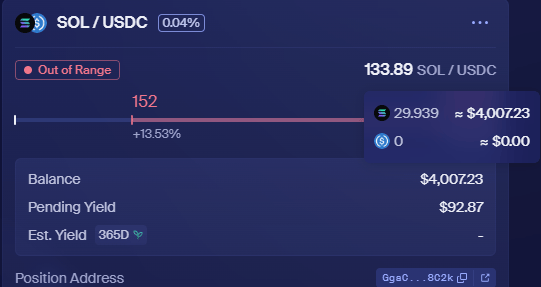
With my SOL/USDC position feeling a little “out of whack,” I’ve been asking myself some hard questions. Am I being greedy? Should I shuffle funds? Should I add more Solana to the farm?
The good news is, these are mostly good problems to have. I’m in the right crypto assets, I’m making progress, and I’m learning to maximize my yield. But let’s break it down—because yield farming is nothing if not a constant learning experience.
Question 1: Did I Set My Range Too Wide?
When I set up my SOL/USDC farm, I made the range wide, hoping to rake in yield over a broader price band. But now that Solana is dancing outside my range, I’m wondering: was I greedy?
The Current Situation:
- Solana dropped below $123 earlier today, and my guru warned that the next stop could be $100.
- As I write this, Solana has climbed back to $144, but it’s still far from the top of my range, which is $208.
The Takeaway:
Setting a wide range can be a double-edged sword. On one hand, it gives you more room to earn yield. On the other, it can leave you stranded when the price drifts too far away.
Question 2: Should I Close This Position and Move Funds to WETH/USDC?
My WETH/USDC positions are performing well, so the temptation to shift funds is real. But should I?
Why I’m Holding:
- Currently, I hold 29.939 coins of Solana, which I bought when it was $30 more expensive per coin. Closing out now would lock in a $1,000 loss in crypto value.
- While shuffling funds might seem like a quick fix, riding out this position could get me back to even faster.
The Verdict:
For now, I’m sticking with Solana. The position still has potential, and I’d rather let it play out than take an immediate hit.
Question 3: Should I Add More Funds?
Adding funds to an out-of-range position can be risky, but it’s also an opportunity to dollar-cost-average and lower my entry point.
What I Did:
- I added a couple more shares of Solana to the farm.
- This time, I didn’t just buy because “the price dropped.” Instead, I consulted charts and indicators to gauge whether Solana had reached a potential low point.
The Lesson:
I’m getting better at timing my additional investments. Yield farming isn’t just about reacting—it’s about planning and making informed decisions.
Question 4: How Much Can I Make if Solana Hits the Top of My Range?
The top of my range is $208, but there are a lot of unknowns:
- Yield Along the Way: How much will the farm generate in fees as Solana climbs back up?
- Will It Even Reach $208? Crypto is unpredictable, and there may be detours and surprises along the way.
- Tighter Ranges, Higher APR: If I eventually close this position and set up a new, tighter range, the APR will likely increase—but I’ll need to decide when and how to do that.
The Reality:
I don’t have all the answers yet. But that’s part of the fun (and frustration) of yield farming—it’s a constant learning process.
Final Thoughts: Mostly Good Problems
Right now, I’m dealing with good problems:
- I’m farming top-tier assets like Solana and Ethereum.
- I’m learning how to maximize my yield and make my positions more efficient.
- I know that aiming for a 50% return is a lot easier than chasing over 100%.
Sure, I’d prefer Solana to magically shoot to $208 tomorrow, but I’m willing to be patient. Yield farming is a marathon, not a sprint—and I’m confident I’m on the right track.
Key Takeaways for Fellow Farmers:
- Wide Ranges Have Risks: They offer flexibility but can leave you out of range for longer periods.
- Dollar-Cost Averaging Works: Adding funds strategically can help lower your entry price.
- Patience Pays Off: Yield farming isn’t about instant gratification—it’s about steady growth and smart decisions.
I’ve got this. My farm is growing, my strategies are improving, and I’m learning to make the most of every position—one Solana coin at a time.


