
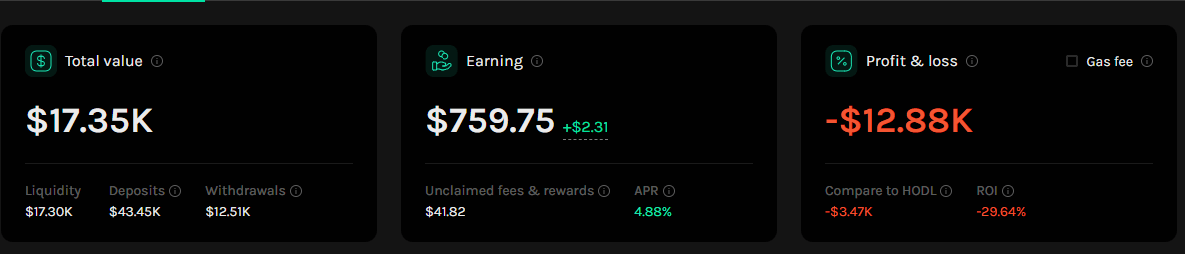
With all the red in the “Profit & Loss” column, I’ve been crying “Uncle!” for a couple of weeks now. But this week, I picked up two new techniques—one from the guru and the other from the guru’s “dad.” These strategies come into play when your liquidity pair is out of range.
The goal: Get the liquidity pair earning again ASAP.
The Double Position
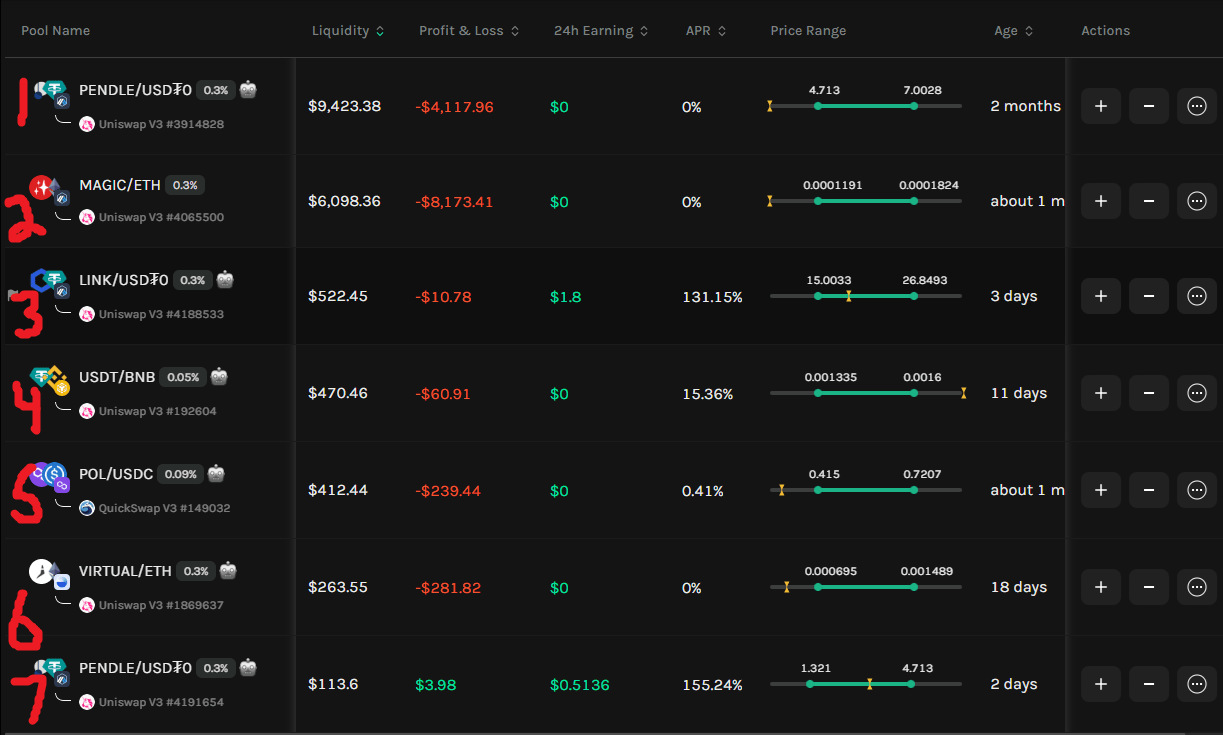
This technique involves setting up a position just above or below your current one, depending on whether your range is too high or too low. You’ll want to position it on the side that will start making earnings right away.
When you set up the new position, make sure one end touches your existing range. With the crypto market being as unpredictable as it is, setting a bigger range than you think you’ll need isn’t a bad idea. It’s all about keeping the earnings flowing, even in turbulent times.
For example, #1 and #7 illustrate this strategy. Setting up the new “double position” is just like setting up the first one—the only difference is the range. If you’re familiar with this, you’ll breeze through it.
Pros: You start making money again immediately.
Cons: Your new position will only earn money on the amount you put into it. Meanwhile, your original position is still waiting for the liquidity pair to get back into its range.
The Snuggle
I’m still getting the hang of this one, but it’s definitely a more sophisticated option.
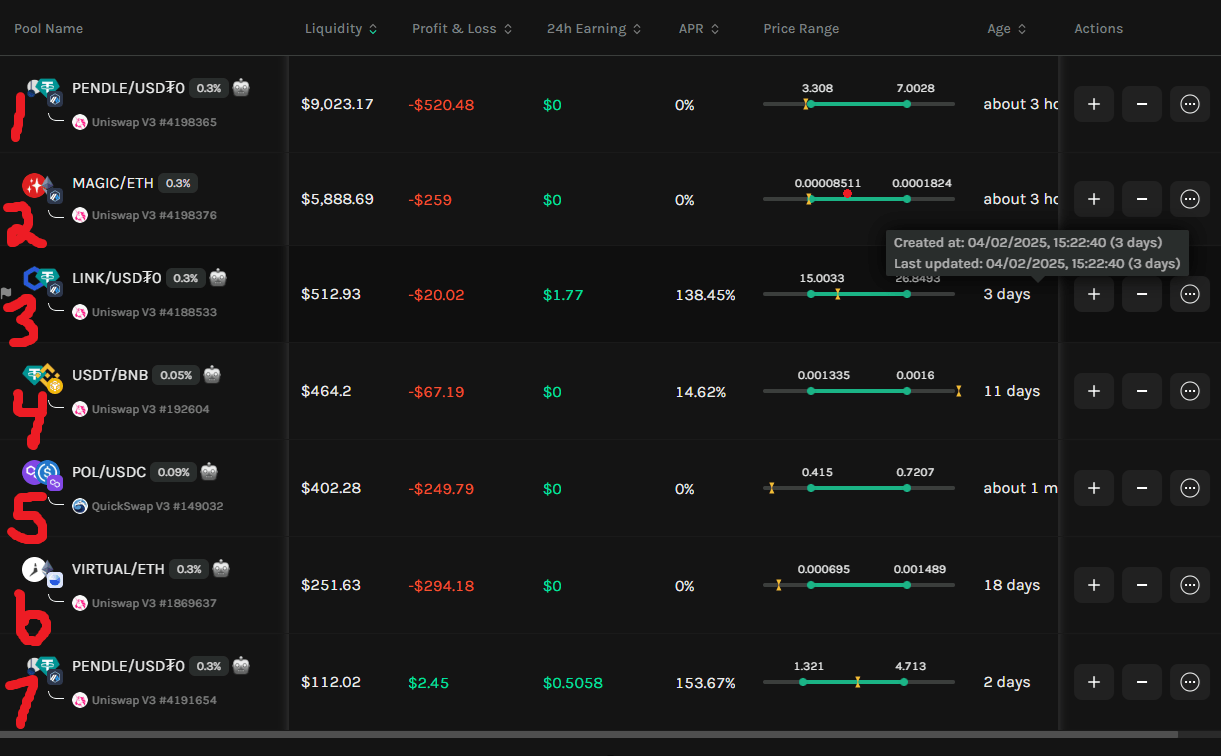
The main advantage of this technique is that it allows you to readjust your range without forcing you to take on immediate losses. Those losses can still be recouped if the market returns to previous levels.
The key here is resetting the range just above or below the current one. For example, with #6, the left side of the range is adjusted so that it’s very close to being in range, but not quite there. (I’m hesitant to give a more specific example, as I might miss something important.)
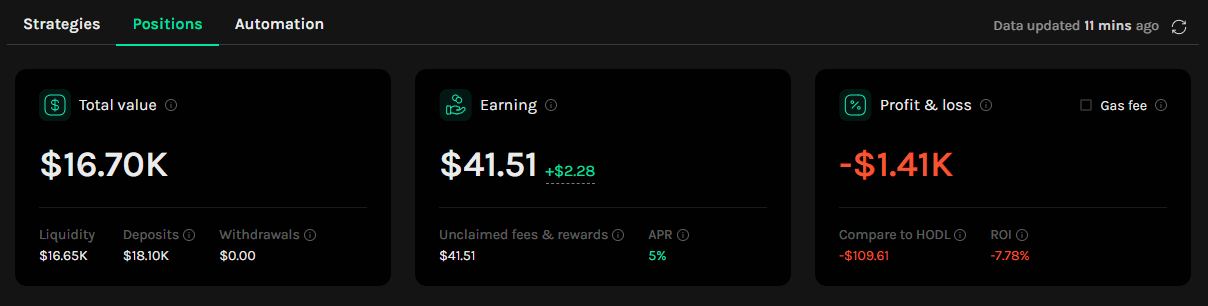
Check out #1 and #2 on both images where my profile is listed. The bottom profile shows the PENDLE/USDT and MAGIC/ETH positions after this strategy has been used. Notice that #1 and #2 on the bottom are nearly back in range.
Pros: All “losses” are preserved. If the market goes back up, you could potentially recover all losses. Plus, you start earning again on the full amount of your position once it’s back in range.
Cons: You don’t earn anything until it’s back in range, and there’s no guarantee it will come back into range.
If you’re interested in chatting with my gurus and starting your own crypto journey, I’d be happy to pass along your contact information.


Pingback: Achieving Crypto Success: Lessons from a Novice Investor - Algorithmic Trading 4UAlgorithmic Trading 4U